Friday, July 24, 2009
Tuesday, June 24, 2008
'The Righteous Men' by Sam Bourne [NO SPOILERS]
Anyway, having read too many books where some middle-aged male with a fairly identikit standard life is motivated to discover a conspiracy of persons by either the kidnapping or murder of a close family member I now limit myself to only one or two a year, such as when they come up for a book group I'm a member of.
The Righteous Men by Sam Bourne is such a book. It's a couple of years old now and of the subset of thrillers called 'vaguely using religious imagery/theology'. Someone from the Mirror has helpfully given the publishers 'The biggest challenger to Dan Brown's crown' which should tell you most of what you need to know. Showing no inclination towards genre-busting at all it at least sets about it's appointed task with vim and vigour: Bodycount? Check. Ridiculous premise? Check. Personal stake? Yep, the wife is kidnapped. No real attempt to make any characters interesting but take time every few pages to remind us how tired and worried about his wife the main character is? Check.
I'm actually being rather unfair to the book. I nipped through this in a few days and it's actually fairly fun and, unlike Dan Brown, didn't make me want to stick two spoons in my head and call myself a strawberry sundae.
Again.
There is one major flaw I found with the book which is, I assume, the fault of HarperCollins and not of Bourne (nee Jonathan Freedland (and if the publishers are willing to expose an author writing under a pseudonym in his own book might it not suggest there's no point using the pseudonym?)). Anyone who was enamoured of The X-Files in the 1990s might have been foolish enough to try reading the awful tie-in novels. In one of the books Mulder and Skully are trying to work out what caused some scene of devastation. Mulder is throwing out ideas about goat-suckers and little grey men and next Thursday in the form of a really angry stoat but he's doing this in a book called something like 'Whirlwind' or 'Twister', which means we readers know that the correct answer is that it's some sort of mind-controlled wind vortex of some kind and we get impatient and cranky with the book until Mulder catches up with us, then we realise we're reading a crappy tie-in novel and try to kill ourselves out of self-loathing.
At 562 pages this book is already trying our patience and it takes about half of those for 'stock hero character' to work out what is going on, that someone is finding and killing 'Righteous Men'. Although a loathsome maggot of a man at least Dan Brown has the sense to give his books meaningless titles like Angels and Demons or The Dave Itchy Code that don't mean anything to anyone. It's no wonder that once 'stock hero character' works out the plot halfway through (and this is no fault of Freedland, it would have been difficult to work it out faster) the book changes gear as we lose our sense of superiority to 'stc' and the novel races along quite nicely.
So yes, if this book were a sweet it would be a stick of rock with 'totally average thriller' written all the way through it, it's probably about fifty pages longer than it needs to be but that's probably because you have to wait longer at airports for your holiday flights these days.
Labels: books
Tuesday, April 22, 2008
BBC7 have a few audio Pratchett treats to celebrate the fella's 60th birthday. From what I remember the adaptation of Mort falls into the 'leaden, dull' category but Small Gods is great fun, not least because of Patrick Barlow as the tetchy and currently-incarnated-as-a-pompous-tortoise god Om. It's brilliant acting from the man who gave us Desmond Olivier Dingle and is one of the many criminally under-appreciated comedians in this country. I haven't heard The Amazing Maurice and his Educated Rodents yet and will be interested, especially as David Tennant is involved.
Labels: authors, books, comedy, David Tennant, Patrick Barlow, Terry Pratchett
Thursday, March 13, 2008
Weisberg reserves most ire for Cheney and Rove, the former a Machiavelli who knows exactly how to push Bush's buttons to get him to do what Cheney wants while the latter worships Bush to such an extent that he's willing to dismantle the American Constitution on his behalf.
I did enjoy zipping through The Bush Tragedy but I expect that one's appreciation of the book will depend on how strongly one believes the central premise about the key players before they even pick the thing up.
Labels: American Presidency, books, George 'Shrubya' Bush, The War Against Terror, United States
Wednesday, December 12, 2007
Crapsticks
I know it's a very human thing to say "Is there anything I can do", but in this case I would only entertain offers from very high-end experts in brain chemistry.
Labels: books, Terry Pratchett
Saturday, December 08, 2007
I did find this book rather disappointing when I put it down. I suppose I was hoping for the Agnostic The God Delusion but instead I got one-third 'If there's a God then why do bad things happen?', one-third 'If there isn't a God then how did the universe start then huh?' and one-third 'We've got a letter from a Mrs Thoughtful of Middle-Englandshire'. Perhaps all that this book demonstrates is that rational sensible argument is unlikely to change the phase-state of a person's belief, that can only occur when they think for themselves. Humphrys largely skirts religion to concentrate on belief, which allows him to put his impartial boot into the Dawkins and Hitchens of the world but the problem is there's no sense of a journey, after a vaguely religious upbringing he lost his faith as a young man and is now an old man and it hasn't come back. In the end he makes Agnosticism seem like the Liberal Democrats of theology, able to stand on the sidelines and take pot shots at the other two positions but not doing much to convert others to the cause.
Labels: Agnosticism, atheism, atheists, books, Christianity, ethics, Islam, Judaism, Richard Dawkins, Rowan Williams
Saturday, November 17, 2007
I do like hardbacks. Providing you're not in a situation where the size and/or weight is an issue then the hardback is your friend. It's sturdy and more difficult to damage which, speaking as someone who winces whenever anyone bends a book's spine or turns the corner over to mark their place, matters. The binding is often better on a book which also matters. When J.D. Robb suddenly rose to prominence a few years back we had a rise in demand at our libraries. The paperbacks of her work (which my Mum read and said were full of spelling mistakes) which were presumably rushed out to meet the sudden demand were incredibly poorly made, and a lot of our stock was unusable after three or four issues. Admittedly, the books were probably taken out by spine-benders and corner-turners but they were cheap and shoddy and, in a market which is apparently moribund (despite getting rid of the Net Book Agreement a decade ago), are publishers not looking for ways to cut costs? A paperback book is designed to last long enough to be read by one person and then put on their bookshop until Judgement Day, where presumably you get in to Heaven based on a Q&A on A Suitable Boy.
The size of the book is also a factor. Something chunky like the aforementioned Vikram Seth or Michael Palin's chunky Seventies Diaries work better with a sturdier cover, in paperback they look like someone trying to fit into clothes a size too small, leaving the reader at risk of a bibliographic wardrobe malfunction.
Paperbacks are nice and cheaper though. And the book market is an oddity, being the only market where something is released, then after a period released again in cheaper packaging, with no extras. At least when albums or DVDs are re-released they give you bonus tracks or deleted scenes goodies (perhaps that's an alternative the books market might like to investigate?) And there are a hell of a lot of authors out there who don't deserve the extra cash that people spend on the hardback. That this is considered standard rather than optional seems crazy. I'd quite like the option of reading a book from the library, perhaps in paperback, and if I like it, ordering a hardback from the publishers that has extra annotations and material, the In Rainbows Boxset approach to novel production you might say.
Still, a positive thing is that Picador isn't pulling a music industry and blaming the falling sales on piracy and are doing something that doesn't involve claiming it's the public's fault. That's a definite plus point.
Labels: authors, books, bookshops, libraries
Tuesday, October 23, 2007
WantwantWANT
Labels: books, gay, Harry Potter
Friday, October 05, 2007
Labels: books, Daily Mail, stupidity
Children's books that don't have happy endings should be banned, it was claimed yesterday. Youngsters are already exposed to enough misery in their lives and should be protected from such stories, says a parents' group. The Happy Ending Foundation is planning a series of Bad Book Bonfires for later this month, when parents will be encouraged to burn novels with negative endings... Among the stories on the foundation's blacklist are best-sellers such as A Series of Unfortunate Events by Lemony Snicket and Marcus Pfister's Milo and the Magical Stones... Adrienne Small founded the organisation when her ten-year-old daughter became depressed and withdrawn after reading the first book in the Lemony Snicket series.
So, rather than minding her own business and just going to the library and suggesting her child read the first Harry Potter book or something like 'Charlie and the Chocolate Factory' Mrs Small decided to start a nationwide society to restrict children's reading. As you do.
Here's the website. I had some difficulty finding it because the Mail misnamed the group as the Happy Ending Foundation rather than Happy EndingS Foundation. But surely, someone is taking the piss? Sad books are bad books. Mrs Small has now left her career as a tax inspector to focus on THEF full-time. She plans to rewrite all 13 Lemony Snicket books to give them happy endings. Her versions will be published on-line - watch this website! I'm sure Daniel Handler and Egmont Books will be watching the website. Wholesale rewriting of a current children's book, I don't think 'fair use' works here.
I don't know. I'm not a parent, but I would have thought that if my child was sad because they'd read a book that made them unhappy I would have tried talking to them about it, or tried cheering them up?
Labels: books, Daily Mail, stupidity
Monday, October 01, 2007
Goddamn it, Listen To Me!
Labels: books, podcasts, science fiction
Friday, September 21, 2007
I did enjoy The Sundial Brigade by James Trimarco, in which humanity struggles for freedom when the Earth is run by alien museum curators rather than megacorps or fascistic politicians. It's one of those stories that I wish were longer so that some of the more interesting throwaway ideas could be more fully investigated, like the idea that bad behaviour by the humans is punished by their being given negative personality traits, like being made smokers or alcoholics. On the other hand, if these traits are investigated you get the novel length version of Isaac Asimov's Nightfall, so maybe the short stories are best left alone.
On the train to work this morning I listened to Niels Bohr and the Sleeping Dane by Jonathon Sullivan. Set during WW2, the war of choice for a country so reluctant to take part in it at the time, it's one of those stories that mingles fact and fiction as it tells of the escape of Danish Jews, including Bohr, through the eyes of a young boy, torn between the competing demands of his rabbi Father and his desire to follow in Bohr's scientific footsteps. I can't really mention the fantasy element without blowing the whole story, but while it's true to say that it's fundamentally a traditional story, I think a number of the plot points won't be surprising anyone, it's notable for the strong relationship Sullivan evokes between father and son, so much so that I'm glad I was busy navigating around the London Underground towards the end of the story and so was occupied at the emotional high points of the story.
On a tangentially connected note, I only recently read Maus and was similarly moved by the relationship between author/artist Art Spiegelman and his father, Vladek, pumping him for the story of how he and his wife survived Hitler's Europe and the death-camps, while finding him so difficult to deal with in the present as he tries to survive in the modern-day USA. The relationship between children and parents seems to be a touchy one for me at the moment, probably the first stirrings of middle-aged angst .
While I'm currently single and don't want a relationship or kids, at the same time there's something buzzing at the back of my head to remind me that by my age my Dad was married with two young children and a mortgage. It's funny how part of me seems to want to measure myself against standards that I feel I've consciously rejected. But I wonder if that conflict is what, at the moment, makes me look for parent-child relationships in stories and resonates with them.
There are more stories at Escape Pod, for sci-fi, Pseudopod for horror and I'm also looking forward to their new show, Podcastle, which will be starting soon to spin off the more fantasy based stories.
Labels: books, personal history, podcasts, science fiction
Monday, August 27, 2007
Labels: books
Wednesday, August 15, 2007
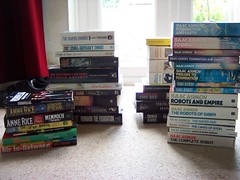
Originally uploaded by Loz Flowers
It was at some point about halfway through Blue Mars by Kim Stanley Robinson that I realised I was unlikely to ever read that book, or Red Mars or Green Mars , the titles that precede it in the trilogy, ever again. Not because they are bad books, far from it, they are wonderfully detailed and vivid hard future-sci about humanity spreading out into the stars, the problems that might cause, the changes it will bring and the chances for making us better people as a result. While the descriptions of most of the science and political theory goes straight over my head and a number of the more colourful characters die in the first book, Robinson never completely loses me.
While I read Red Mars some time in the late Nineties (I think around 1997) and Green Mars some time towards the start of the new Millenium I didn't get around to Blue Mars until this Summer. This wasn't completely down to forgetfulness on my part, there were no copies where I used to work and the book seemed to be out of print for a while, then I forgot all about it, until I got to where I'm working now. And I was lucky, it was the last copy and hadn't been out in two years, so the lack of a good fiction weed was all that enabled me to get my mitts on the book.
But it was the fact that I could go five or six years without a burning desire to read the last part of the trilogy that made me realise that the other two books were just taking up space on my shelves, at a time when above them there was a pile of around thirty books that weren't shelved because I had no space left.
I'm very resistant to getting rid of books, it offends my librarian spirit. Books are to be treasured, with the possibly exception of those by Katie Price or Jeffrey Archer. I have a permanent pile of around fifty books which constitute four 'to read' piles, some of the books have been there for four or five years now, mainly because I have less time to read these days and library books have to go first. But a few years ago an almost complete set of Colin Dexter paperbacks went into the book sale at work as I realised that once I had read one of his incredibly convoluted plots that always seemed to revolve around mistaken identity in one form or another. And, when I pulled the Mars books off the shelf I realised "Hang on, those Isaac Asimov books have been sitting there unread even longer than these two. And I didn't even like The Gobbler when I read it after buying it some time in late 1995."
And that was pretty much that. Most of the stuff you see above are books that I would classify as 'good', the pile of Asimov's books are pretty good books, detective novels with robots and spaceships for the most part. If I had an eleven-year-old boy nearby who liked science-fiction I would happily unload them on him, that was about the age I started reading Asimov and most of them are ideal for that age, except for his later books, in which incredibly beautiful and large-breasted women fall in love with old science professors repeatedly. Full Whack or Mr In-Between were perfectly adequate reads when I bought them, I just never read them again.
There are a few stinkers in there too. The aforementioned The Gobbler for example. I only bought that because I happened to be walking through the Birmingham Waterstones one day and Adrian Edmondson was sitting there. I can't remember if it was towards the end of his signing session but there was no-one going up to see him so I bought a copy of the book and got him to sign it. Thankfully time has rusted my experience of reading it but I remember it being awful. Some unfunny runaround farce involving an actor and a psychotic stalker I seem to remember. I probably held on to it for so long only because it was signed. The Anne Rice books are from the end of the period of time I liked her work, the mid-Nineties, when I found her work progressively weaker. I'm keeping hold of her earlier and better work such as Interview With the Vampire , The Witching Hour and Cry to Heaven which is probably up there near the top of my list of favourite novels (though what on earth the cover of the edition I've linked has to do with the story I've no idea). Hannibal by Thomas Harris is going because it bored me, the collection of his two previous books because I haven't read them for best part of a decade either.
The pile is very unfair. If 'not reading' was a criteria, my Douglas Adams books should probably be there too, especially considering how bad MOstly Harmless was. But it'll do for now.
The question is, what to do with them now? There's the book sale at work or I still have a Book Crossing ID somewhere, though I always have difficulty finding somewhere to leave the book, I don't want the embarrassment of someone trying to return to me a book I've deliberately left behind somewhere. I'll have to have a think about that.
Sunday, July 22, 2007
Labels: books, Harry Potter, music
Harry

Yes, even Alan Moore is enjoying the last Harry Potter book.
Oh shut up , that's the last time I'll be able to use that joke...
So, the boxes turned up at work on Friday, with strict instructions that we weren't to open them or put the books out until Saturday, so we were stricken by existential doubt, what if we opened the boxes and the books weren't there? Still, on Friday night I slept the sleep of the just, unlike the poor sods who had to work at midnight at another library for the Potter party for the children who wanted to be the first to get the book at a minute after midnight. I heard one child, on receiving his book, turned immediately to the back page to find out what happened. Well done J.K., six hundred and six pages of work and the child is going to ignore six hundred and five of them. Mind you, in order to see how many pages my copy had I've just mini-spoiled it for myself and now know at least one of the major characters that's making it to the end of the book. Damn. Still maybe he/she has all their limbs chopped off along the way.
So we had a dozen copies of the children's edition of The Deathly Hallows and three copies of the adult version. Personally I've never seen the point of the adult versions with their deliberately boring and non-specific covers. If you are ashamed to be seen in public with a copy of the book with the cover for children then you shouldn't be reading it! And what, you think people aren't going to see the words J.K. Rowling and Harry Potter and the Final Cash-In on the boring cover of your 'adult version'? Or perhaps, has J.K. Rowling edited the adult version so that Harry is actually a smack addict who can't get it together to fight Lord Voldemort because he thinks the carpet is trying to eat him? Is Hermione unable to help him because Ron got her pregnant during the Summer holiday and she's now down the Muggle housing office?
Anyway, I've got my copy, of the Children's Edition natch, and will see if I can finish it before some insensitive bastard tells me the end (I was going to say 'ruins it for me there' but then realised that would imply that I actually care about this at-best competently written kid's story). All our copies in the Library were issued by the time we closed yesterday.
Labels: books, Harry Potter, libraries
Tuesday, July 17, 2007
OK, this might work...
The second book is a load of pish, but the first one, Dirk Gently's Holistic Detective Agency isn't too bad, though most of the funniest jokes come from the authorial voice, not any of the characters. And I probably would have gone with Richard E. Grant myself but never mind. But as Harry Enfield has spent most of the last seven years trying to make people forget he was ever funny, is he going to be any good in this?
Labels: books, Douglas Adams, fiction, radio, science fiction
Saturday, July 14, 2007
Actually, I would suspect that bookshops like Barnes and Noble do classify their stock so that people working in the shop can find them, what they don't do is tell the public what the classifying is, so that you just have a row of shelves with the travel books in order, so this is potentially just the spirit of Dewey without the numbers on the spine of the book.
Still daft though.
Labels: books, bookshops, Dewey, libraries
Wednesday, July 11, 2007
Thursday, June 14, 2007
This film is not a hysterical lefty polemic against authority. It's a calm, measured and sometimes bleakly funny reminder of what we have lost, taken by those that would claim that in doing so they are saving us from fanatics. Check the website, if you can find a showing you can attend it's well worth a few hours from your life to watch this film and let it anger up the blood. It also suggests some easy, low-impact ways you can start to help the fight back, some of which I intend to follow myself.
I'm currently reading We Need to Talk About Kevin by Lionel Shriver, which I'm finding a rather annoying read. Pitched somewhere between Frankenstein and The Omen a middle-aged woman reminisces in letters to her estranged and, I suspect, possibly dead ex-husband about her life and the upbringing of her son, Kevin. From the moment of conception he's been a little bastard causing misery and pain to all around him and somehow his mother puts up with him long enough for him to reach his teenage years and shoot up a classroom of kids at his school.
The language the mother character uses is ridiculous but thankfully calms down after a few chapters and resembles English as used by real human beings. I suspect that this book is supposed to be read by people who don't believe that children can be malevolent creatures when it suits them, it's a horror story for middle-class yummy mummys to read while their little darlings are wrapped up in bed. While Daddy is away at work all day Mummy has to put up with Kevin and his permanent malicious behaviour, Daddy minimises every single act of bad behaviour and blames Mummy for overreacting, even when Kevin starts causing injuries to other people. I've just got past the midway point in the novel and Mummy is now pregnant with baby number two. She's a lot more positive about this child and Daddy is not happy, so I expect a hundred pages of Daddy regarding the girl child as the very spawn of Satan's loins. Sadly we know already from the text that we aren't going to have both children fighting on the Golden Gate Bridge with the fate of humanity in the balance, which is the sort of level this story is going for.
I'm not anticipating the second half of this book being the part that shows me why this book won the Orange Prize several years back.
Labels: books, children, civil liberties, freedom, Fundamentalists- Islamic, movies, Muslims, The War Against Terror, Tony Blair


